









AIDEVI Wellness Guide
How to Run an nmn Before-and-After Trial Without Fooling Yourself
Before you compare “before” with “after,” write down the exact outcome you will judge, which observations count as comparable, and how you will summarize them. Mark disrupted days instead of deleting them, and do not select the best result after the fact. This can reduce hindsight and cherry-picking, but it cannot prove NMN caused a change or replace clinical advice.

A personal before-and-after log is not a clinical trial. Pick one primary outcome and a small set of context notes before collecting results. Use the same measure consistently, record disrupted days instead of hiding them, and review the full pattern rather than the best day. A wearable can add trend information, not proof of cause.
Content
- What can a personal before-and-after trial actually tell you?
- How do you define one question and one primary outcome?
- How do you build a fair baseline?
- What should stay stable, and what should you log?
- How can you review results without cherry-picking?
- Can a wearable prove that NMN changed sleep?
- When should you stop self-testing and ask for help?
What can a personal before-and-after trial actually tell you?
A personal record can show whether one chosen observation changed while you used NMN and what else changed alongside it. That can make a healthcare conversation more specific. It cannot isolate cause: the difference may reflect ordinary variation, expectations, another habit, or several factors together. “I noticed this after I started” is not proof that NMN caused it.
A home notebook is not a formal N-of-1 study. Formal single-patient studies use a planned design, defined outcomes, and often repeated or randomized periods with research or clinical support. A PCORI report describes such protocols and notes challenges with adherence and interpretation. [3]
Likewise, a placebo-controlled NMN study tests a defined routine and specified outcomes; it does not establish a universal consumer tracking window. [1] For calendar review points, see AIDEVI’s 30-, 60-, and 90-day NMN tracking guide. This page focuses on reducing bias, not repeating that timeline.
How do you define one question and one primary outcome?
Write the question before looking for a result. “Is NMN working?” is too broad: it could mean energy, sleep, exercise, a lab value, or general wellness. Choose one outcome that matters to you and can be recorded consistently. Keep other observations secondary so you do not search many measures later for a favorable result.
Make it concrete. Instead of “more energy,” use the same personal 0-to-10 rating at the same part of an ordinary day, with the endpoints defined in advance. For sleep, pick one observation such as bedtime or how rested you feel. These notes are not diagnostic tests.
Set a review rule in advance: what pattern is worth discussing, what counts as no clear difference, and what makes the period too disrupted to interpret? For example, compare the same weekday rating, keep every entry, and mark travel or illness instead of deleting those days.
Example: If your question is about afternoon energy, rate it at the same time on planned days and note caffeine, illness, or travel. Before starting, decide how you will compare all those entries. If caffeine changes midway, label that stretch as harder to interpret; do not treat the result as a clean NMN comparison. Your personal threshold is a planning rule, not a clinical cutoff.
If you are unsure which outcome matters, identify the decision first: convenience, tolerance, a personal routine goal, or a clinical concern. AIDEVI’s article on why NMN experiences differ between people explains how the person, product, routine, time, and measurement can change the context. Another person’s result is not your benchmark.

A short, repeatable note is easier to compare than a changing story about how the week felt.
How do you build a fair baseline?
A fair baseline resembles ordinary life, not an unusually bad week. Starting after illness, poor sleep, or a major routine change can make a return to normal look like a supplement effect. Memory also gives vivid days more weight than ordinary ones.
Note your usual sleep, caffeine, activity, meals, other supplements and medicines, plus symptoms already present. Include weekdays and weekends if they differ. No NMN-specific baseline length is established for consumer self-testing; follow a clinician’s monitoring advice when provided.
Record the exact product, form, label serving, start date, and lot or batch if available. AIDEVI’s NMN certificate-of-analysis guide explains what batch-linked documentation can tell you about the item, not what outcome you will experience.
Keep original notes. Leave missed entries blank rather than guessing, and label disrupted periods honestly. A needed medical change comes before a neat baseline.
What should stay stable, and what should you log?
Keep relevant conditions stable when practical, but do not postpone a useful or medically needed change for the sake of an observation. Never change prescription medicine to make a comparison cleaner. If treatment or daily life changes, follow the appropriate advice and mark the period.
Log only context relevant to your outcome. For afternoon energy, that may include sleep, caffeine, illness, travel, and strenuous activity. For sleep, note schedule changes and late caffeine. AIDEVI’s NMN, coffee, and breakfast routine guide discusses common morning variables; this article does not prescribe timing.
| Log field | What to write | Why it matters |
|---|---|---|
| The question | One outcome and how you will record it. | Prevents moving the target later. |
| Product exposure | Product, form, label serving, dates, lot, missed or changed days. | Shows actual exposure. |
| Primary measure | Same rating or observation, time, and format. | Makes entries comparable. |
| Context changes | Sleep, caffeine, travel, illness, stress, training, or routine change. | Flags possible confounders. |
| Review note | Changes, missing entries, and your pre-set review rule. | Separates notes from interpretation. |
Copy the table into a journal or notes app. Leave missed entries blank, add brief context to unusual days, and apply the same review rule throughout. Do not remove a day just because it makes the pattern less appealing.
How can you review results without cherry-picking?
Read the full sequence. Check adherence, then review the primary outcome using comparable days and times. A weekly summary may make fluctuations easier to see, but it cannot remove confounding or prove cause.
Do not compare the best “after” day with the worst “before” day or delete an inconvenient result. Leave missed entries blank. Mark changes in product, serving, caffeine, exercise, or sleep. An imperfect chart with honest notes is more useful than a polished chart built from selected days.
| Pattern you see | What the notes support | What they do not prove | Reasonable next step |
|---|---|---|---|
| A repeated change while the routine stayed similar | A personal pattern worth reviewing. | That NMN caused it or that it will generalize to others. | Discuss the record in context; do not turn it into a health claim. |
| No clear change in the chosen outcome | Your log did not show a clear difference under these conditions. | That NMN has no biological effect or could not affect anyone. | Revisit your goal, cost, routine, and professional guidance before deciding what to do. |
| Several changes overlapped | The result is difficult to attribute. | Which one change explains the result. | Label the period as unclear; do not invent a cleaner explanation after the fact. |
| A concerning or worsening symptom | The routine needs a safety review. | That it is safe to keep testing until the cause is certain. | Stop the supplement and seek appropriate medical advice; do not deliberately restart it to test a theory. |
Can a wearable prove that NMN changed sleep?
No. A wearable can show a trend but cannot identify its cause. Consumer sleep devices estimate sleep; they do not reproduce a clinical assessment. In a 2025 comparison of six wrist-worn devices with polysomnography in 62 adults, agreement varied by device and measure. [2]
If you include a wearable, choose one metric in advance and keep the device consistent. Note software updates, missed nights, and major schedule changes. Do not treat brands as interchangeable or infer a result from one night or an unverified sleep-stage score.
Keep device data separate from a simple observation such as bedtime or how rested you felt. If they disagree, record that. A wearable is a tracking aid, not a diagnosis or proof that an ingredient caused a change.
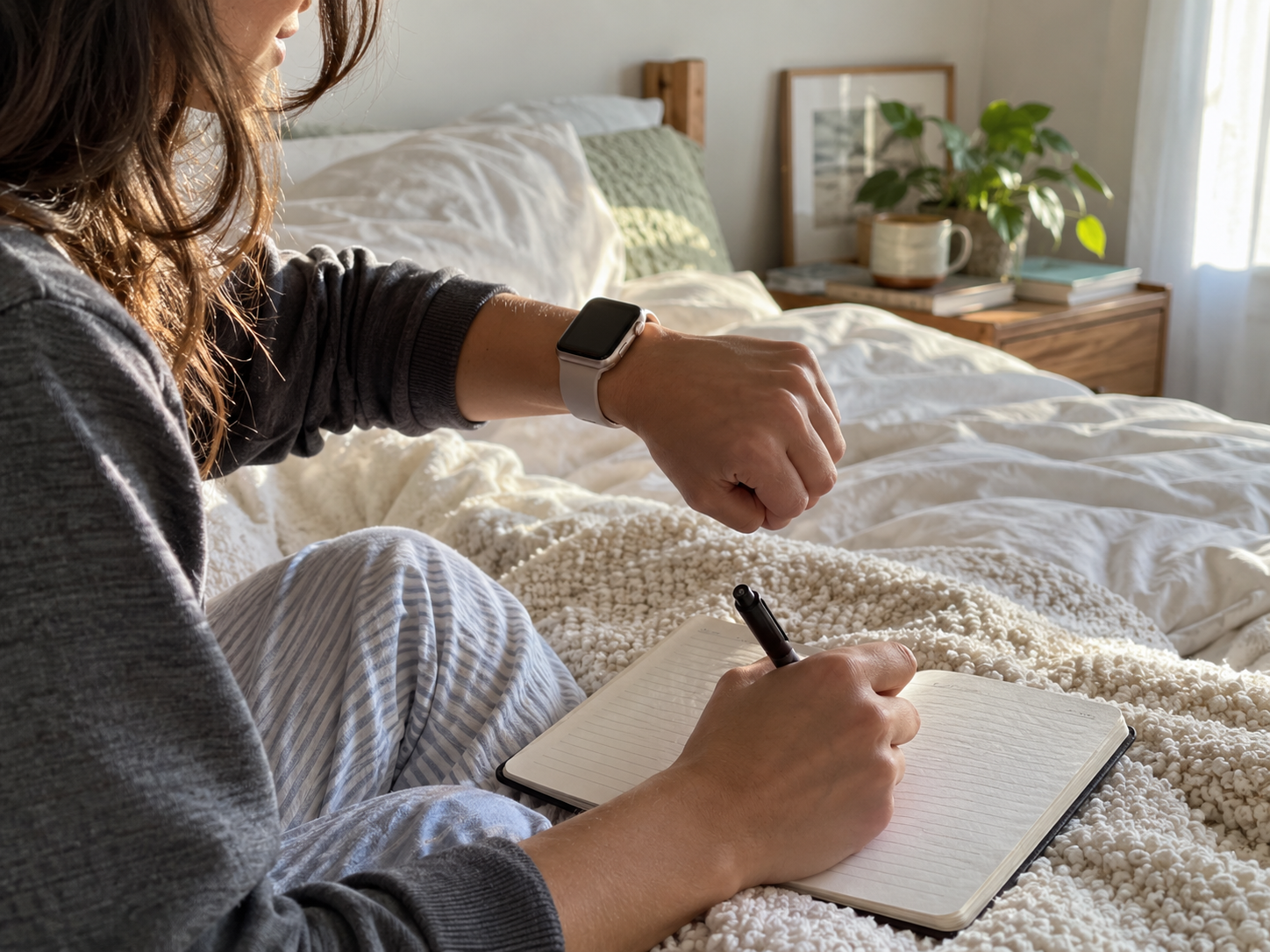
A device can show a trend; it cannot tell you what caused it.
When should you stop self-testing and ask for help?
Do not use a tracking plan to delay care for a new, persistent, worsening, or severe symptom. The FDA advises consumers who experience an adverse event while taking a dietary supplement to stop using it and seek medical care or advice. It also cautions that supplements can interact with medicines and that combining supplements can create additional risks. [4] Do not stop or change a prescribed medicine to make a supplement comparison easier.
Ask a healthcare professional or pharmacist to review the full label and your medication list before changing a supplement routine if you take medicines, manage a health condition, are pregnant or nursing, or are preparing for a procedure. Bring your product, label, dates, and notes. AIDEVI’s guide to NMN-related symptom questions and what to do covers the difference between an observation and a reason to seek help.
If symptoms are severe—such as trouble breathing, chest pain, fainting, or sudden neurological changes—seek urgent medical care. Do not continue taking a product to collect more data, and do not deliberately restart it after a concerning reaction to see whether the symptom returns. A clean experiment is never more important than safety.

A concise timeline and the actual label can make a professional review more useful.
Conclusion
A more honest NMN before-and-after review starts before the first comparison: define one question, record a representative baseline, keep the outcome and routine readable, and decide how you will review the notes in advance. Mark missing data and life changes rather than hiding them. A personal log can reveal a pattern and improve a professional conversation, but it cannot prove that NMN caused the pattern. If a symptom is concerning, stop self-testing and put safety first.
Frequently Asked Questions
Is an NMN before-and-after log a clinical trial?
No. It is personal tracking. A formal N-of-1 trial uses a planned research design and may involve repeated or randomized periods, defined measures, and clinical or research support. A home log can organize observations but cannot provide the same causal evidence.
How long should I track NMN before deciding?
There is no universally validated NMN self-test duration for consumers. Choose a review point that suits the specific outcome and your healthcare professional’s advice. A calendar checkpoint is a planning aid, not a promise that a benefit should appear by then.
How many outcomes should I track?
Choose one primary outcome and only a few context notes that help interpret it. Tracking many outcomes makes it easier to find a coincidental change after the fact. Keep secondary observations clearly labeled as secondary.
Can a smartwatch show that NMN improved my sleep?
No. A smartwatch may help you follow a trend when used consistently, but its sleep estimates vary and cannot establish what caused a change. Keep device data separate from your own observations and do not use it to diagnose a sleep condition.
Should I restart NMN to see whether a symptom comes back?
Do not deliberately restart a supplement after a concerning reaction just to test causality. Stop the product and seek medical care or advice, especially if symptoms persist, worsen, or feel severe. Never change prescribed treatment without the prescriber.
Medical disclaimer: This article is for general educational purposes only and is not medical advice, diagnosis, or treatment. Consult a qualified healthcare professional before starting, combining, or changing supplements, especially if you take medication, are pregnant or nursing, or manage a health condition. Do not delay care because of information on this page. These statements have not been evaluated by the Food and Drug Administration. This product is not intended to diagnose, treat, cure, or prevent any disease.
References
- Ingestion of β-nicotinamide mononucleotide increased blood NAD levels, maintained walking speed, and improved sleep quality in older adults in a double-blind randomized, placebo-controlled study. (2024). PubMed.
- A performance validation of six commercial wrist-worn wearable sleep-tracking devices for sleep stage scoring compared to polysomnography. (2025). PubMed.
- Kaplan HC, et al. Understanding How to Use Single-Patient Studies to Answer Patient-Identified Research Questions. Patient-Centered Outcomes Research Institute. PubMed / NCBI Bookshelf.
- U.S. Food and Drug Administration. FDA 101: Dietary Supplements. FDA consumer guidance.
